Sunday, March 3, 2013

Feb. 18-22

I learned this week in chemistry that if one knows the molar mass of an element, one can find the density of an element, such as hydrogen and oxygen. In the beginning of the electrolysis lab, I hypothesized that the density of hydrogen would be less than that of oxygen based on: 1) Hydrogen has the least atomic mass of all the elements on the periodic table. 2) In an electrolysis video I saw, I noticed that the bubbles in oxygen were packed more closely together while hydrogen's had more space in between.

Hydrogen, although less dense, has twice as much
volume as hydrogen as shown in the balloons.
For review sake, in water, hydrogen has a 2-1 ratio to oxygen. But, how does could one find this out? One clue is looking at the chemical formula of water (H2O). Obviously, this means that for every particle of water, hydrogen would have twice as much volume as oxygen. Why? Because it takes up twice as much space as oxygen.

But, how could I find a way to prove this true? Well, this week, my group and I did an electrolysis experiment. We had to hook up two probes to two metals ends at the bottom of the trough. We had to fill the trough with sodium chloride water solution. But, why not water? This is the part I felt I wasn't so sure of, but I think it had to do with the fact that sodium chloride could conduct electricity in order for the hydrogen and oxygen particles to chemically split.

Then, what we had to do next was use two graduation cylinders (one for hydrogen and the other for oxygen) and put them on top of the metal ends making sure that they are still full. The tricky part was to do so and sort of break the rules of physics–in other words, have none of the tubes with the sodium chloride water solution gravitate down the tubes. To do, I learned this with trial and error. It then came to me after the experiment that it was like the gas-trough lab where the bottles had to be filled with water and put in the trough and still remain full. The only difference, which screwed me up, was imagining that I was using a lens to cover the top of the tube. So, I had to approach this differently. Scoop the tubes with the solution and slowly tilt them to the bottom of the trough, then tilt it again toward the metal end and cover it with the tube without going over the top of the tube.

Scientific notation review:
a) With small numbers less than 1, the exponent is negative.
b) With large numbers greater than 10, the exponent is positive.
Then, after that ordeal was over with, I then cranked this device and repeatedly turned the handle clockwise. (Note: this device was hooked up with the electrolysis apparatus before we began the experiment). We then kept track of the volumes for each of the tubes filled with the hydrogen and oxygen. Every time we recorded the data, there was twice as much volume of the hydrogen as there was oxygen. One example of this being true is when hydrogen took up 8mL while oxygen took up 4mL. Now, the objective was to find the density of the gases. My group and I looked up the gases and found hydrogen to be 0.089 L and oxygen to be 1.429 L. But, since the graduated cylinders were measured in mL, we wanted the densities also in mL, so we converted by using proportions we learned from last week.

There was 3.5 mL of oxygen left in the tube. The question was to determine the molar mass of H2O by finding the molar masses of H2 and O through experimentation and mathematics:

To find x grams of oxygen for 3.5 mL:

3.5 mL*1.429g  *    1 L
              ----------   -------------
                 1 L         1000 mL

The answer is 0.005g, but by using scientific notation, the answer is 5.0*10^-3 g for oxgyen.

Twice as much volume as the oxygen, the volume of hydrogen left in the tube was 7 mL. Also, the same process was used for hydrogen in order to find the x grams of hydrogen per mL:


7 mL*   0.089g    *    1 L
             -----------     ------------
                 1 L          1000 mL

The answer is 0.000623g, but by using scientific notation once again, the answer is 6.23*10^-4 g for one hydrogen.

Based on this lab, I have concluded that hydrogen is less dense than oxygen. Therefore, my hypothesis was correct. Doing more research on hydrogen and oxygen to further support my hypothesis, oxygen has a greater atomic mass (16) than that of hydrogen (1). The atomic mass ratio between 1 oxygen and 1 hydrogen, therefore, is 16-1. But, the ratio with 1 oxygen to 2 hydrogens, is 8-1. This proves that oxygen still has a greater density than hydrogen–just a double dip ratio from 16-1 to 8-1.


But, I still wonder what would have happened if the probes (the anobe and the cathobe) were hooked up differently? Would that have altered the results possibly skewing them, or left them the same? Keeping in mind that everyone turned the handle clockwise, what would have happened if we turned it counter-clockwise? Would this have affected which tubes the hydrogen and the oxygen would have gone into? It seems to me in the picture above that the anobe attracts oxygen and the cathobe attracts with hydrogen. If that is to be so, then I think it's possible that oxygen may have a negative charge while hydrogen may have a positive. I think that since there are two hydrogens and 1 oxygen with a 2-1 ratio when combined to make H2O, I think that oxygen has a -2 charge while the two hydrogens have a -1 charge each. This would further help to explain why the two can chemically combine to form a compound. Now that I think about it, the anobe (negative) and the cathobe (positive) if were flip-flopped may have the same impact on where the oxygen and the hydrogen go. Here's some thinking ahead: Through the electrolysis lab, I wonder if next week I will learn about how electrons may tie into electrolysis?

Sunday, February 24, 2013

Feb. 11-15

This was the one thing that I was still thinking about. Isn't it possible for atoms of different elements to have different masses? Indeed, this is so. You can look at the Periodic Table of Elements, but the more interesting thing is how did they find the atomic mass of the individual elements?

To answer this question, one must overcome this fallacy: Assuming that elements bond because they have the same mass. This is not true. This was proven in our experiment with oxygen and magnesium. The mass afterwards was 0.33g. If we were to prove they had the same mass, the mass would have doubled when the two were combined–that wasn't the case. When 0.2g of magnesium was burned, it bonded with O2 since magnesium was not a diatomic element. So, 2Mg bonded with O2. Therefore, this formed 2MgO2.

Based on this, I figured that I could find a ratio between the masses of the elements. Considering that Mg+O=0.33g and that Mg=0.2g, the mass of oxygen was 0.13g. Mg to O has a relationship of 1 to 0.65. Then, I considered the Law of Multiple Proportions, which means compounds should have a proportional rate of the amount of elements as the mass of a substance increases definitely.

But, how did it form 2MgO2? Well, I hypothesized that the magnesium combined with the O2 in the atmosphere since the magnesium went through a chemical change when it was burnt, so it had to have changed into a different substance by bonding with another element.

I also then thought of comparing the ratio of Mg to MgO. Knowing that there are 0.2g of Mg and 0.33g of MgO, I set up an Algebraic proportional relationship between the two. Assuming that MgO is the total amount, I can make it equivalent to any number (let's just say 1) while Mg would be equivalent to x. It wouldn't matter, though, which proportional value I equated to MgO since there must be a definite proportion of elements in order to have the same substance. So, by doing this, I found that Mg to Mgo is 1 to 1.65, which means that MgO has 65% more mass than Mg. Therefore, in spite of the number of particles of Mg and O so long as the ratio is equivalent, it is still MgO.

This week, I applied the Law of Multiple Proportions to what I've also learned this week. In class, I did an experiment with my group. The goal was to compare the mass of 1 item to all the rest. The items were an empty bottle, small brown nails, hexnuts, pennies, screws, washers, bolts, and panel nails. To do the experiment, the first item we measured the mass of was the empty bottle. We found out it was 9.5g, and since all the elements had to stay in bottles, we subtracted 9.5g from all the rest of the total masses to find the masses of the small brown nails, hexnuts, pennies, screws, washers, bolts, and panel nails.
However, we had to choose one item to compare to all the other objects. Since the small brown nails had the least mass, we decided to compare it to the other items, and we found the ratios of their masses to the small brown nails. The picture above shows the data. The small brown nails had a mass of 1.3g, the hexnuts 18.9g, the pennies 11g, the screws 10g the washers 23.6g, the bolts 7.1g, and the panel nails 4g. The small nails to hexnuts were 1 to 14.5, small nails to panel nails were 1 to 5.46, the small nails to pennies were 1 to 8.3, the small nails to washers were 1 to 18.15, the small nails to screws were 1 to 7.69, and the small nails to bolts were 1 to 5.46. Therefore, I have concluded that small nails were the smallest, and the washers have the largest mass since the ratio between small nails and washers was the greatest.

I still felt ambivalent, though, on particles. How can I represent them in a collective group? This question was then answered as I learned in class that for every mole, there are 6*10^23 particles. Thus, the word mole is the collective group of particles.

However, I wondered how I could apply this in the real world. I then thought to myself that it is possible to find the number of moles of any object (e.g. 500g of H2O). Knowing that for every mole of water is 18g, how many moles are there in 500g of water? To find this out, I proportionally represented 500g/Xmoles to 18g/mole. I then found out that for every 500g of water, there are 27.78 moles. But, I still want to find out more about how a mole consists of 6*10^23 particles and how to find out the number of moles in any object without relying on current information. But, how many particles are there in 27.78 moles of water? By knowing how many particles are in a mole, I multiplied (6*10^23) by 27.78 moles of water. I found out that it is equivalent to 166.8*10^23. But, is this the correct way to answer this question? No, because I remembered when I learned about scientific notation in 7th grade. If I remembered correctly, when using scientific notation, a number being multiplied by 10^X has to be less than 10, and since this number is more than 10 and is two value places away from 1.668, I think the correct answer is 1.67*10^25 (since I moved two places back, this would mean adding two more place values).

I then realized that through this lab, this was how scientists found the atomic masses of the elements. They compared it to hydrogen, which happens to have the smallest atomic mass, to all the rest. Also, the overall concept I learned from this was that there can be some way of calling 6 pieces of hardware to 1 collective group (e.g. 1 dozen=12 items). 1 dozen would be the collective group. So, we came up with a collective group name for the 6 hardware pieces: Quinn. Therefore, proportionally speaking, for every Quinn, there are 6 hardware pieces and vice versa.
When doing these kinds, I consider what it is that I'm finding to find. For every X amount of Quinn, how much of the hardwire pieces are there? To solve this problem, I recalled what it was like doing Algebra, so it reminded me of it. In order to find the number of hardware pieces, multiply your unknown value by (Q/6g). Then, you multiply 6g by 5Q to get 30g. Therefore, for every 5 Quinn. there are 30g.

For this problem, flip flop Q/6g since this problem asks for every 24 g hardware pieces, how many Quinns are there? Multiply 6g/Q by the unknown value X, which is equivalent to 24g. Then, divide the total mass by the amount for every Quinn. Therefore, I found out that for every 24g of hardware, there are 4 Quinn.


Sunday, February 10, 2013

Jan. 26-29

What happens when you chemically mix zinc and hydrogen chloride? What will be the reactant (product)?

This is the experiment I did with my group this week. The challenge was to answer the above question.

I hypothesized that since hydrogen and chlorine are already chemically bonded together and can't bond with the zinc, I figured that the hydrogen or the chlorine would escape from the system and combine with the gas in the air while the zinc would stay in the system since it's a metal.

In order to find out what the reactants will be, my group and I first considered the mass of the zinc, the beakers, and the hydrogen chloride. To measure the zinc, we just put it on a measuring scale to calculate its mass. Then, to find out the mass of hydrogen chloride, I figured that in order to do so, we must find out the change in mass when comparing the beaker's mass to the mass of the beaker and the hydrogen chloride in it. Then, I subtracted the mass of the beaker with the total mass, therefore, to find the mass of hydrogen chloride.

By finding the masses of all these variables, we figured this would be the best way to find out the total mass after the zinc and the hydrogen chloride are chemically combined together, that is, by combining the masses of hydrogen chloride and zinc before they were combined. I assumed that since hydrogen or chlorine would escape from the system, the mass would have to decrease.

However, to get an accurate result, we made sure nothing new entered or left the system to increase or decrease the mass. So, we used a trough, which has an extension cord with a cork attach to it. By capping the beaker with the cork, this can help to trap the reactants in the beaker.

So, my group and I thought of an experimental procedure. To find the volume of the reactant, we would fill a different bottle all the way with water while filling the trough with water. Then, mix the zinc and the hydrogen chloride together. But, we had to seal the beaker quickly so that the gas wouldn't escape. Keeping in mind that the tube is attached to the trough, the gas goes through an opening inside the trough. So, to collect the product, you should fill a bottle with water and tip it over right side using a lens to prevent spilling. Remove the lens once done. Then, combine the zinc and hydrogen chloride so that they will chemically react to form a new substance.

Then, gradually wait until the water level drops and then to collect the gas without it escaping, use the lens once again and flip it up.

Now, with the gas in the bottle, my group and I can test it's chemical properties to determine what the gas is. Hydrogen, for example, is flammable (think the Hindenburg), and oxygen is combustible. To determine if the gas had these properties, we lit a match to test for combustibility and flammability. Once we put the match in the container, the flame got brighter. Therefore, the gas was flammable. When the match got in contact with the gas, a sound was made. Therefore, the gas was combustible.

Also, you can find the density of the gas to determine what it is. To do so, keep in mind the beaker's mass. But, measure it again. It should have changed. Subtract the mass of the beaker from the total mass. Then, find the volume of the gas by looking at the bottle. If there is any condensation on the bottle, this indicates the amount of space it takes up. Then, you divide the mass of the reactant by the volume in which it took up the bottle to find the density. (Do this before testing the gas's properties so you can calculate its density correctly).

With these results, we concluded that since the gas was combustible and flammable, it had both oxygen and hydrogen. But, what happened to the zinc and the chloride? And how did the oxygen get in the picture? We conclude that since the air has oxygen, and since it is diatomic, it combined with H2 (hydrogen molecule) to form water. This would then make sense since the inside of the bottle had condensation on it.

Zinc Chloride
But, what happened to the zinc and the chloride? We noticed that those were left in the beaker that was capped. The zinc, I noticed, dissolved in the chlorine, and when that happened, it formed zinc chloride. But, they chemically combined together. Through this experiment, we identified the two separate reactants: H2O and ZnCl.

After this experiment, I had a hunch that I would then learn about writing chemical equations. I then thought that by combining chemical substances, I could identify the chemical composition of the reactants by writing out their chemical equations. To do so, you need to know what the beginning products consist of. Then, what the reactants consist of.

When writing chemical equations, I noticed that it was like doing Algebra. Remember this? 2(XY)=2X2Y. By using this, you use the distributive property, which is when you multiply the outer term by the inner terms. Here is an example of the distributive property in chemistry: 2(H2O)=(2H2)(O2).

I then wondered what the difference was between these: H2O2 and 2 OH. At first glance, it seemed as if H2O2 was a single compound while 2HO was two compounds. Even though they have the same elements and the same number of those elements, they are different chemical compounds. H2O2 is Hydrgen Peroxide while 2 OH are 2 OH molecules.

Sunday, February 3, 2013

Jan. 22-25

This week, I learned about the concepts of Dalton's theory.

Dalton's Playhouse Visual Learning
On Monday, I did a simulation on Dalton's theory in the computer game. The first part of the game consisted of burning the calx (Priestley). As 7.39g of the 100g calx was burned, only 92.61g remained. This time, I tried 200g of calx. Using my understanding of the Law of Conservation of Mass, I predicted that twice the amount of mass from the first trial would burn. It turns out that this was true. The change in mass was 14.78g was subtracted from the 200g calx. Therefore, depending on the mass of a substance burning, it loses mass at a proportional when comparing it to the same substance with a different mass.

However, I considered this: What about the volume of gas that was in the experiment? Well, I figured that the more mass was burned, the more volume the calx would be surrounded in since mass and volume have an indirect relationship. Using the 100g, the volume of gas came out to be 5.171L, and then using the 200g, the volume of gas came out to be 10.34L. Therefore, since there is only half of the mass of calx left, the volume doubled. Also, the volume of gas changed at a proportional rate to the rate at which the mass of calx changed.

So, this then establishes a core Dalton principle: Chemical reactions occur at a proportional rate. This is indeed true as everything else (mass, volume, etc.) change at that same proportional rate.

The next experiment I did in this activity was the Lavoisier stage. This is where the phlogiston and the oxygen were tested at burned at different rates to see how they would change in mass or volume. First, 1/3 of the phlogiston was burned. To begin with, both started out with volumes of 6L and they were both in separate beakers , which had tubes connecting to a center beaker, which is where the gas would go. As the oxygen and phlogiston burned, 5L for both were left.

Next, as 2/3 of the phlogiston were burned, 4 L for both oxygen and phlogiston were left.

So far, one could extrapolate that they would change at the same rate based on the results of these two trials. However, when all the phlogiston was burned, only half of the oxygen was consumed so that 3L of oxygen were left.

Therefore, this concludes that phlogiston burned at a quicker rate than oxygen. But how? And why? I speculate that it has to do with the fact that phlogiston was more flammable, therefore, it would burn at a quicker rate. Then, as soon as I realized that phlogiston was renamed hydrogen, I then thought, "Of course!" And I then thought of the Hindenburg incident where it blew up because the hydrogen that it was filled with was flammable, and so when it came in contact with the flame (presumably from an explosion), the Hindenburg exploded. Therefore, I think that hydrogen is flammable possibly because it may be just able to bond with almost any element since it makes just one bond (hence, any element can make one or more bonds). Overall, hydrogen burned twice as fast as the oxygen in the Dalton simulation.

Both consist of a similar chemical composition and consist
of carbon. Therefore, they change mass and volume at
the same rate and number during a chemical reaction.
Lastly, I worked on the Diamond and Charcoal lab. I started out with 0.20g of charcoal and diamond and kept the mass of oxygen at 1.06g and volume at 0.74L constant (charcoal and diamond were tested individually). The mass of the oxygen decreased from 1.06g to 0.73g as the subtracted amount went to the 0.20g of charcoal, thus increasing the mass of charcoal to 0.53g. Next, 0.40g of charcoal was tested with the same volume of gas (0.74L). Then, the mass of gas dropped from 1.06g to 0g and the volume dropped from 0.74L to 0L. Therefore, with twice the mass, the rate at which volume dropped doubled, hence the rate at which charcoal's mass increased. Hence, chemical reactions occur at a proportional rate and inversely affect each other, and subtracted amount is added somewhere else in a closed system.

Then, 0.20g and 0.40g of diamond were tested. The results were the same. Thus, charcoal and diamond have similar chemical properties (e.g. melting point, boiling point, etc.) so that they can change at the same rate and may consist of the same kind of elements (carbon, for example).

From this lab, I learned that chemical reactions occur at the same rate, whether they are in a closed or open system. I learned that the amount of mass in a closed system would stay the same while in an open system, the total mass of the reactants won't come out of the system. Based on this, volume could be affected as well. If the mass left the system, then the volume would increase. But, if it is in a closed system, the total volume won't change.

Monday, January 21, 2013

Jan 15-18

This week, I learned more about the difference between mixtures, compounds, and elements.

Essentially, this reminded me of when I had to learn this in 6th grade. I had a vague idea of what each were and their differences. So, I went with my hunch and guessed that mixtures were like putting Snickers in a shake. Even though you physically combine both, you don't change any of their properties. The Snickers are still Snickers, and the shake is still a shake. Now, compounds are a different story. If I remember correctly from 6th grade, compounds were when two or more elements were chemically combined and their properties changed chemically. Elements were their own separate entities that contained their own properties.

Over this week, we went over problems involving this topic. We looked at pictures on the Google Drive. One of the pictures looked like two blacks combined together. At a first glance, it seemed to me like an element, but as I looked closer, I realized that it may be different from the elements that were combined to make this arrangement. So, this question came up in class: Is it an element, or is it a compound? This then reminded me of O for Oxygen and O2, and H for Hydrogen and H2. One rationale was that since two of the same elements combined, then they would be still an element. Another argument was that they combined to form a different compound. So, what is it? One or the other? Or, is it something? However, we did come to a consensus that this was a diatomic substance. But, I then realized that this was a molecule. Therefore, I came to the conclusion that diatomic elements are molecules, that elements of the same kind can combine to make molecules, and that neither seemed to change chemical properties. I think, therefore, that since they both had the same properties, they combined without changing their properties.

Next, I looked at two pictures. One showed one element combined to a different element and then another one with a different element but not combined. The top picture shows two elements in a substance not chemically bonded. Therefore, this is a mixture because the elements have still retained their properties, and as a result, they haven't changed. On the other hand, the bottom picture showed two different elements chemically combined together. Therefore, this is a compound because their properties have changed as they have formed a new substance.

In class, here was another challenge. Let's just say that there were 2 pairs of H2O and each pair represent 100 mL, so there are 200 mL of H2O overall. The question was this: What percentage of volume does each take up? This means don't look up the atomic mass of hydrogen and oxygen. So, what I did was this. I considered the H2O molecule overall. The water molecule consists of 2 Hydrogens and 1 Oxygen. Therefore, I considered a 2 to 1 ratio. So, overall, H2 is 2/3 of water molecule and the oxygen was 1/3. But, we are only considering half of the overall volume. This is fine, though, at least this demonstrates an overall understanding of how much space each element takes up in a molecule. Even though there were 2 H2O molecules, the percentage of Hydrogen is still 2/3 (67%) and the percentage of Oxygen is still 1/3 (33%). Also, one way of considering this is drawing H2O and H2O in a box, then separating the H's and the O's. What you get is two H2 pairs and 1 O2 pair. If you did this correctly, you should get a 2 to 1 ratio. You should get 4 H's and 2 O's. The total is 6 elements. Therefore, the fraction of H's is 2/3 of the volume, and the fraction of the O's is 1/3.

So, what are their volumes overall? Since Hydrogen consisted of 2/3 of 200 mL, there are 134 mL of Hydrogen, and since Oxygen consisted of 1/3 of 200 mL, there are 66 mL of Oxygen. Therefore, no matter how many molecules you consider, the ratio must remain the same in order to correctly calculate its overall percentage.

Next, there was this problem: hypothetically, there are H2 in a container of 50 mL and O2 in a container of 50 mL. What would be the volume of the two if they were to combine? Suddenly, I had this hunch that this was H2O2 (hydrogen peroxide). I remembered that this was mentioned in 6th grade, so I considered that if they combined, then they would form a new substance. But, how would that affect the volume? Well, I thought that since they chemically formed a new compound, the volume would be 50 mL based on the overall average of the volumes. So, this makes me think of the possibility of the volumes of two different elements together combining and then averaging out to equate to a new volume in case the volumes were either the same or different.

Monday, January 14, 2013

Jan. 8-11

This week, I learned about examining the physical and chemical properties of various during class.

In class, my group and I were doing a group experiment. The challenge was to separate these substances understanding their individual properties. The substances we had to separate were sand, salt, bird seeds, and iron filings.

So, what we did was we used our background information on iron. What do we know about iron? Well, this reminded me of the one time when I had to bring in cereal with traces iron in it, smash it into tiny bits, pour into a cup, and then use a magnet on the side of the cup to attract the iron. So, I then had an aha moment. I realized that iron had magnetic properties, so we could use a magnet to get them out.

But, how is iron magnetic? Well, we learned in our 5th grade science class that there were two opposite poles that would attract or repel substances. But, that doesn't explain how or why iron is magnetic. I speculate that it has to do with the magnet's chemical and physical properties. Iron may have electrons arranged in a way that will allow it to attract to the magnet. I think it is possible that iron, other magnetic substances, and the magnet itself have similar chemical configurations, which is why they attract to the magnet.


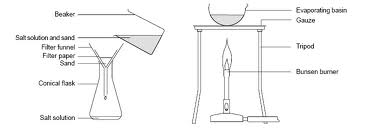
Next, I considered filtering bird seeds since one bird seed is larger than that of a grain of sand or salt. First, though, I needed to know how I was going to separate, but I had to find the why part first since it seemed important to understand more of its properties. I then started thinking about density. I wondered if the density of a bird seed was more or less than that of water. So, I then poured water into a beaker and then put a bird seed in it. It floated. But why? I then started connecting it to its density. The density of bird seed was less than that of water, which is 1 g/mL. Next, I considered possible ways to get the bird seeds out. Since iron is out of the equation, I could pour the rest of the solution into the beaker of water. I figured that since salt and sand stay at the bottom of the sea floor of the ocean or any body of water for that matter, they would sink at the bottom because they have a higher density while the birdseeds would stay afloat. Or, I could use a funnel and fold a coffee filter into it and gradually pour it with water and scoop out the bird seeds until they are completely gone.

However, the main question left is this: How would you separate the sand and the salt when their granule size is so similar? Well, the salt granules are probably smaller than that of the sand.  The salt's chemical composition is sodium chloride, while the sand consists of a mixture of minerals. To filter them out, though, it seems the only plausible method is to filter out the sand since its granules seem to be slightly larger. If we found a screener with small enough space to let salt stay in and large enough to get the sand out, then the salt would still be on the screener while the sand would be pored somewhere else through the screen's spaces and then evaporate the water to possibly separate them.

Or, consider this. Salt is more soluble than sand. Sand is denser than water but isn't soluble. It is possible that by pouring both into water and stirring the solution to get the salt to dissolve that the sand would eventually sink back to the bottom. So, one way of getting the salt out is to scoop out the water with the salt without the sand.

This week, I learned about physical and chemical properties, elements, compounds, and mixtures. First off, physical properties are merely the physical descriptions of an element (e.g. density, solubility, color,   melting and boiling points, etc.), while the chemical properties are their chemical descriptions (e.g. flammability, reaction rate, etc.). To review, density is the certain amount of mass (g) in a certain amount of space (mL). It will determine whether a substance will float in any liquid substance. For example, iron will not float into water because it has a greater density, whereas, oil will float on top of water because its density is less than that of water. Next, solubility is the ability to dissolve in any liquid substance. We looked at ethanol and water in class and poured sugar into each. I hypothesized that since ethanol had more viscosity (resistance to flow), it would be harder to dissolve sugar in it. As sugar was poured into both, it took a longer time for sugar to dissolve in ethanol.


I then learned that elements are single pure substances, mixtures were compounds physically mixed together. Compounds were elements chemically mixed together. Take a look at iron and sulfur, for example. If you were to smash the two substances and then physically mix them together, they would just be a mixture of iron and sulfur. Knowing that iron is magnetic and the two substances aren't chemically bonded together, you could separate the iron from the sulfur using a magnet. However, if you put them in a test tube with water and them heat the test tube, they will make iron sulfide. Since these two are chemically bonded, there is no way you could get the iron out using a magnet because the chemical structure is different than the magnet's chemical structure.

Sunday, January 6, 2013

Dec. 19-21


Brise de Mer company logo
This week, I learned how to make soap. It was a fun educational experience where we could make our own soap in a hypothetical situation where we own our own company and had a logo.

During the soap making experiment, I learned that the most effective way to work is to split up the work evenly so that everyone can contribute without one person doing everything. For example, two members took pictures of the soap-making steps and the soap. Next, I assigned one other group member to get the supplies and choose the ingredients to use and to make our company logo, which is Brise de Mer. Lastly, I decided to collaborate all the photos and the research on soap into Evernote to make a Soap Project Notebook and share it with the class.

To make the soap, we decided to use, for essential oils, olive oil, and for colors, pink, some white, purple, and orange. We decided that we would use holiday wrapping and packaging and molds.
These are the steps used to make the soap:

•         Materials needed are glycerin, knife, beaker, hot plate, thermometer, essential oils, coloring, fragrances, rubbing alcohol, soap molds, gift wrapping materials.

Packaging, glycerin, essential oils, colorings, and molds.
•         Chop glycerin into 4-8 blocks.

•         Then put the glycerin blocks in the beaker.

•         Then, put the beaker on a hot plate. Adjust at medium heat (5-6). Change adjustments accordingly, but avoid boiling if you can. In order to determine if it boils, notice the condensation on the glass. If the glass appears cloudy, then the soap solution is over boiling. If it does boil, turn down the heat for about a minute and then gradually increase from 0-5.

•         Next, watch glycerin melt. As it turns from a solid to a liquid, add essential oils, colors, and fragrances.

How soap bars came out in the end.
•         Then, stir the solution with a spoon or straw.

•         When the temperature of the solution is around 54 degrees Celsius, pour solution into soap molds.

•         Once you pour the solution into soap molds, bubbles will appear. To avoid excess bubbles and to keep the soap layers sticking together, spritz a bit of rubbing alcohol.

•         Then, let the soap solutions in the molds cool for 24 hours so that they solidify. Then, the next day, each solution should look like a typical bar of soap one uses in the bathroom ready to wrap!

•         Lastly, package them.

The soap changed different states. When melting the glycerin, it changed from a solid to a liquid around  54ÂșC. Then, once the soap solution, after adding colors, essential oils, and fragrances, is poured into the soap molds, the soap solution changes from liquid to solid as it cools over 24 hours. The particles became more and more structured and crystalline as the temperature dropped, causing the particles to move slower.


In the melt and pour method, what occurs is glycerin is melted on a heat melter or large double boiler. Then, fragrance, essential oils, moisturizing agents, dyes, or exfoliating agents are added. While hot, the soap can be poured into molds where cooling will occur.
Particle motion of soap during melt
and pour method.

When making soaps, it is important to consider what fats are added in the soap. This is important because fats have different crystalline structures and chemical bonds. So, chemical bonds can occur at different rates at different temperatures and at different rates. For example, if a fat with a very crystalline structure is used to make soap, it will be difficult making soap at low-moderate temperatures because it will require a higher temperature to melt this in order to change its state of matter, or a longer period of time for energy configuration to increase to make the particles move farther apart. Different fats, thus, affect the outcome of the soap.


Thus, the soap with the crystalline-structured fat has the highest density yet the lowest energy configuration since the particles are closest together and move the slowest, and the soap with the less crystalline-structured fat has the least density yet the highest energy configuration since the particles are farther apart and move faster.

Lastly, temperature is an important factor in the melt and pour process. The higher the temperature of the soap is, the more gel-like your soap will become since chemical bonds and attractions between particles are being broken and there is enough energy in the phase account to make the soap change state. But, if the temperature is lower, then the chemical bonds and attractions between particles won't be broken as much, and there may not be enough energy in the thermal or phase energy accounts to make the soap change state.