Friday, November 23, 2012

Nov. 19-21

Last weekend, I added the finishing touches to my thermos to test it in an in-class competition. The competition's objective was to retain the most amount of energy and to have the least temperature change.

The previous weekend, I reflected on what materials to use for the thermos in order to retain the most amount of energy. As I was thinking, I thought that insulators would be the best materials to use. Essentially, an insulator traps energy in for longer periods of time, so it takes longer to heat up and to let energy go.

Thinking about this, I decided to use a Styrofoam box as the outermost layer of the thermos with insulation inside, and the materials included: Styrofoam and a Styrofoam cup, carpet insulation, duct tape, super glue, tin foil, peanut tin cans, and plastic wrap. Next, I used carpet insulation and tin foil since they have water vapor barriers, which lessened the temperature change and kept the energy in. Duct tape and super glue retained heat inside the thermos since they are good insulators and keep the thermos intact to prevent more energy from escaping. The cotton T-shirts and the plastic wrap were wrapped around the cylindrical thermos to reduce heat loss and retain the temperature of any liquid in the thermos longer. The peanut tin cans served as the outermost lining of the cylindrical thermos and soaked moisture from the insulation, and the peanut can lid was used as the inner lid to keep energy in longer.


Last weekend, I stuffed the Styrofoam box with carpet insulation, glued it down, and secured it with duct tape around the Styrofoam cup. First, though, I had to use a hand saw to saw off the bottoms of the tin can from the peanut tin cans, and then I cut the carpet insulation into 2-3 circles and used those as the base of the peanut tin cans. I then wrapped the Styrofoam cup with 8 layers of T-shirts and tin foil.

Next, I performed three tests: at 10ºC, 20ºC, and 30ºC. What I did was I used tap water and made sure the temperatures were correct. I then performed three trials at those three temperatures individually by pouring them in the Styrofoam cup. Then, I sealed the lid on the thermos and recorded the temperatures using the thermometer through a straw that went through the top of the Styrofoam box.


On Monday, the competition commenced. I tested the water at 80ºC (353.5 K) at 355 mL. My procedure was to get the water in the thermos as quickly as possible. So, I used tongs to lift the flask with the water in it and pour it into the thermos. However, I had to keep in mind that time was my worst enemy–if I didn't seal the thermos quickly, the temperature change could increase since more energy would be able to escape. Thus, I sealed the thermos quickly and only adjusted it when I saw it fit. However, I took out the straw that may have reduced heat loss had I not have removed it, which may have partially accounted for the 
increasing change in temperature.


For twenty minutes, I recorded the temperature change in the water. When it was time, it was 70.5ºC, thus a 9.5ºC change over the course of 20 minutes. I wasn't pleased with this, so I decided to make improvements on my thermos. I had a hunch that on Monday if I had 10 more minutes to test my thermos, the temperature would be around 60ºC. So, I wanted the temperature change to be reduced by at least 10ºC. So, on Monday night, I added insulation and super-glued it on the lid inside the thermos to reduce heat loss.


Then, I tested on Tuesday for 30 minutes with the water at 80ºC at a volume of 355 mL. This time, I didn't take the straw out so that the temperature change could be lessened. 


I felt less stressed about messing up on this lab–rather, I felt excited and confident that I could do well. So, I readily poured the water into the Styrofoam cup and then sealed the thermos without removing the straw. Next, I recorded the temperature from 80ºC to 72.5ºC, thus a 7.5ºC change. This was 2ºC higher than the temperature of the water after 20 minutes on Monday. I speculated that since the water's temperature on Monday after 30 minutes could be 60ºC, the temperature of the water on Tuesday after 30 minutes could possibly be a 12.5ºC change from Monday's possible temperature.

Although this speculation is possible, it is true that since Monday's results were less than that of Tuesday's–even during 20 minutes of Tuesday's lab–the results improved because more insulation was added to prevent less heat from running away.


During this week, while I was doing my lab, I finished up my presentation. I thought I did really well on it. On the presentation, I added information on the materials I used, and I gave a brief explanation for each and explained why they were used. I defined what a thermos was in the first slide to demonstrate its overall purpose, which is to retain energy and keep temperature constant. Next, I recorded information on the lab and the temperature changes from the pre-lab, Monday's lab, and Tuesday's Lab. I also made graphs for the data from the labs, and I added pictures of my thermos. I also updated it over the weekend to scientifically explain that on Tuesday, the temperature change was less than that of Monday's because I added carpet insulation on the lid of the thermos, which retained more energy in, thus lessening the change in temperature.

Sunday, November 18, 2012

Nov. 12-16


This week, I learned about heat and energy and temperature.

In the past, I used to confuse the three and said that they were the same thing. However, I learned that heat is the transferring of energy, whereas, the energy itself is just energy.

I also learned about how two substances of different affect the overall temperature and the amount of heat when they are separately put into two containers of the same liquid at the same temperature.

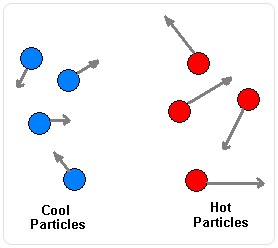
For example, the temperature of the 200 mL of water is 5ºC, and the two substances are each put into separate containers of water at the same temperature individually. The two substances are 40 mL of water at 50ºC and 80 mL of water at 25ºC. Using my prior knowledge on the direct relationship between temperature and energy, I noted that the 80 mL had less particle motion while the 40 mL had greater particle motion since its temperature was higher.

However, I wasn't so sure if having greater particle motion in a substance that was twice as hot and had twice the volume would increase the temperature of the 5ºC water.

Problem to solve in this experiment: How would both of the
containers of water (A and B) at different temperatures affect
the temperature of the other container of water (C)?
Yet, I hypothesized that the 40 mL of water at 50ºC would increase the water temperature more because I figured that temperature, not the volume, would play as a factor in increasing the temperature.

So, in a class experiment, my group and I poured the 80 mL of 25ºC water into the 5ºC water. The temperature increased to 7ºC. Then, we got rid of the water to measure the temperature of the water correctly, since we were measuring the change in temperature after adding the 40 mL of 50ºC water to the 5ºC water. The temperature increased to 9ªC.

Therefore, I hypothesized correctly that the 40 mL water would cause greater temperature change in the 200 mL water.

But, why did the water at 50ºC have a greater change in temperature than the water at 25ºC?

Well, let's consider that the 80 mL water had more water particles than the 40 mL, and the 40 mL water had greater temperature. The question is which one has the greatest amount of energy? Without a doubt, the 80 mL had the greater quantity of energy since the volume was greater, so there are more particles than in the 40 mL as well.

Data from Wednesday's experiment shows the water
from 0-200 seconds as more heat was added to the water.
But, why is it that the 40 mL caused the 5ºC water to have greater temperature change than the 80 mL? This is so because the temperature had a greater degree of energy to make particle motion greater, in contrast to the 80 mL, which had a lesser temperature, thereby a lesser degree of particle motion. So, if it were put into the 5ºC water, then the 80 mL water would give more energy input into the water than the 40 mL water.

The 40 mL, though, had greater degree of hotness than the 80 mL since the temperature was greater.

However, the greater quantity of heat was in the 80 mL since there were more particles and more energy, since the volume is greater.

Therefore, the degree of hotness (temperature) depends on the speed of the particles, NOT the number of particles. The 80 ml water lacked in speed, but had greater mass. so mass and speed determined its greater energy input. At first, my head was swirling around this concept, but this helped to sum up the difference between temperature and energy. The degree of hotness=temperature. The quantity of hotness=energy.

I further understood how energy functioned as I understood more about what it was. There are three principles about energy:

  1. Energy is  a substance-like quantity that can be stored in a physical system.
  2. Energy can be “transferred” from one system to another and so cause changes in the system.
  3. Shows the concept that temperatures remain the same
    even though energy is being transferred to another
    system.
  4. Energy still remains the same after being transferred.


But, energy is not substantial. You can’t touch it or measure its mass on a balance. However, it can be transferred as well as stored. The third point is important because in middle school, I thought of energy transformations as something changing into something else rather than it being lost or gain in a system. To clarify this, I considered the information metaphor in class: Is music still the same even if it were on a CD-ROM or on an mp3 player? Yes, it is. Therefore, even if energy moved in different ways, energy still remains the same. It doesn't change. So, when energy from the 40 mL of water was added into the 200 mL of water, its overall energy still remained the same. It was just added into the 200 mL, but it didn't quadruple like bacteria or break down like food during digestion. Thus, the quantity of energy can be changed, but the degree energy cannot be changed.


Monday, November 12, 2012

Nov. 5-9


This week in class, I learned how to measure atmospheric pressure using a barometer I made outside of class for a project, and how to mathematically find the pressure, temperature, volume, and number of particles.

Making my barometer for the project, I used the materials to make one: a jar, a balloon, scissors, an index card with mm markings, tape, and a straw. I used the scissors to cut off the round part of the balloon, blew into the balloon and then deflated it, wrapped the balloon on the rim of the jar, taped the straw onto the balloon, and taped the index card on the jar. From this project, I learned that a barometer measures air pressure.


On Wednesday, my class and I went outside to experiment with our barometers. As we went outside, the atmospheric pressure increased, so the barometer needle went up. The needle went up because outside, two factors played a role in atmospheric pressure: temperature and pressure. Since it was cold outside and there weren't many clouds in the sky, this meant that the cold air, denser than the warm air, pushed down on the warm air, or the warm air remained above the cold air. Thus, air pressure increased. Since it was cold outside, I figured the cold air pushed down, but not necessarily on the warm air. It may not have pushed down on the warm air because it is possible that the water evaporated because the air was warm enough to do so, and then the clouds condensed before the cold air pushed down.

I noticed that the needle on the barometer went up because the colder air exerted greater pressure on the balloon, thus accounting for the increasing downward force. Then, as the balloon is pushed downward, the needle goes up because of the elasticity in the balloon providing a counter upward force (torque) to lift up the balloon at the point where the balloon dips. I also learned that as we went inside, atmospheric pressure went down, since the atmosphere inside is mostly warm air. Thus, the decreasing pressure pushing onto the balloon causing the needle to go down.

This week, I learned how to do mathematical problems involving temperature, volume, number of particles, and pressure. I learned that the secret to do these problems is to keep in mind that when you are trying to find the change of one of the factors, you have to make that you keep them proportionately related to each other.

This problem involves volume and temperature. For example, a flask with water in it is on a hot plate (pressure and number of particles are constant). The temperature is 25ºC, and the volume is 50 mL. Then, in five minutes, the temperature is 50ºC. So, what is the volume? The fishy thing about this is that the temperatures are NOT in Kelvins. Thus, I converted 25ºC and 50ºC to Kelvins by adding them each to 273.15 since -273.15ºC is equal to 0 Kelvins.
Next, I set the temperature and volume as proportions since their rate of change is proportional. I then used the least precise number to make it easier to calculate the volume. So, I rounded 298.15 to 298 and 323.15 to 323.

Set them up in these steps: (Remember, x=temperature in Kelvins after the water has been heated. To set these proportionally, the initial temperature should be divided by the new temperature. So, the volumes have to be set up the same way since they both have direct relationships with each other.)

  1. 298/323=50/x
  2. 298x=50(323)
  3. 298x=8075
  4. x=52 mL.
The volume of the heated water after five minutes is 54mL, which supports the idea of expansion–the increasing temperature causes the liquid to rise, thus, the volume increases.

Next, I learned how to calculate pressure and the number of particles (temperature and volume are constant). For example, I have a syringe needle, and I have 5 puffs (particles) in the syringe needle. The pressure is 7 k/Pa. Then, I added 3 more puffs into the syringe needle in a closed system, thus increasing the number of particles. However, I had to convert to atm, or atmospheric pressure–air in the atmosphere exerts force per unit exerted onto the surface. 1 k/Pa=0.00986923266716 atm. So, 7 k/Pa=0.069 atm.

Next, divide the original number of particles by the new number of particles and set this equivalent to the original atm over x atm (x atm being the new pressure), since the number of particles and the pressure has a direct relationship.

Set them up in these steps:
  1. 5/8=7/x
  2. 56=5x
  3. 11 atm=x
Thus, the new atmospheric pressure is 11 atm. Therefore, the greater the number of particles, the greater the pressure is.

Sunday, November 4, 2012

Oct. 29-31, Nov. 1-2

This week, I have learned about the relationship between Kelvin and Celsius, how pressure and temperature affect the motion of particles, how low and high-pressure systems are caused, and reviewed last week's material for this week's assessment.

This week, we learned about pressure affecting the motion of a syringe needle using 2-liter bottle filled with water–one with a syringe needle in a closed system and the other in an open system.

I learned that as we squeezed the pop bottles, the syringe needles went down because the volume decreased, accounting for the increased pressure. So, these two factors caused the force to go upward. As the force reached to the top, there was even less volume to go up, since the syringe needle provided some resistance, so the force went downward since it was exerted onto the syringe needle.

But, since one was in a closed system and the other was in an open system, the one in the closed system went down easier since nothing went into the syringe needle and resisted the downward motion. However, in the open system, there was upward resistance in the syringe needle since some water got into it, but it wasn't enough to prevent the downward force since it had greater pressure than the upward resistance, thus causing the syringe needle to go down, but not as quickly.

This week, I also learned how the temperature affects the motion of particles in glow sticks. My group and I experimented with the different temperatures of water and put the glow sticks in the water. We found that the relationship between the brightness of the glow sticks and the temperature is that as the temperature increased, the brightness increased because the temperature increased the motion of particles and their traveled distances. However, the glow sticks in the cooler water didn't glow as much because the particles were more closer together, didn't move as quickly, and didn't move greater distances. Therefore, the temperature of the water affected the brightness of the glow sticks.

Understanding that particles have motion, I also speculated that there was a point where there wasn't any motion at all. I learned that Absolute Zero is the point where particle motion stops because at Absolute Zero, there is neither any energy input, nor is there any pressure.

The mathematical equation for Absolute Zero is:
Pressure=(pressure/Celsius)(Absolute Zero in Celsius)+(pressure when T=0ºC)

These are the steps to find Absolute Zero in this example:


Absolute Zero is -273.15ºC, or 0(K).
To convert Kelvin to Celsius: 
  • kelvin = degree Celsius + 273.15  
To convert Celsius to Kelvin:
  • degree Celsius = kelvin - 273.15
For the weekend, I am working on a barometer for a chemistry assignment. So in class, I learned that a barometer is an instrument that measures atmospheric pressure, and the liquid inside of it expands or contracts based on the pressure it measures. Although somewhat similar to a barometer because they are both instruments of atmospheric pressure, a manometer is an instrument that measures difference in pressure from atmosphere to system of gas, in contrast to measuring atmospheric pressure itself.

This week, Sandy was the major topic everywhere–on TV, in the news, in my journalism class–even in chemistry. Although it didn't cause the most damage, it was considered to be one of the worst hurricanes in history since it had the greatest air pressure. Since hurricanes occur in low-pressure systems, this caused hurricane Sandy to expand. A low-pressure system is caused by greater heat in the air, decreasing its density, causing it to rise and lowering atmospheric pressure downward toward the Earth's surface. As the pressure lessens, the moisture increases. The heat then causes storms to occur by causing the liquid water to condense, thus explaining why hurricanes move from the Gulf of Mexico to the coast.
However, in a high-pressure system, a hurricane would contract since pressure acts upon the hurricane and resists it. In a high-pressure system, a great deal of pressure is pushing down on the Earth's atmosphere, thus discouraging the formation of storms and hurricanes, since cold air is more dense than warm air; causing the warm air to go downward while the cold pushes down upon it. That's why it's bright and sunny in a high-pressure system.

Kinetic Molecular Theory is the overall theory that supports what we learned in class about particles, states of matter, energy and motion, temperature, volume, and pressure. Particles are always in motion, particles in liquid collide with container, change in energy affects motion, all states of matter involve particle motion, matter exists in three states of matter, increasing temperature increases particle motion, and volume and pressure have an inverse relationship.


Review from last week:


Volume and temperature have a direct relationship.


Volume and pressure have an indirect relationship.

Temperature and pressure have a direct relationship.


The number of particles and pressure have a direct relationship.


Sunday, October 28, 2012

Oct. 22-26

In chemistry this week, I learned about expansion, contraction, and the relationship between pressure, volume, temperature, and the number of particles.

On Monday, I was reviewing with my class the ethanol and water experiment–both were heated on a machine over a certain amount of time and given energy through the process of heating–and why the ethanol in the tube rose while the water didn't. The answer is expansion. Expansion is when a liquid takes up more volume as its volume is increased by more energy input through heating. Therefore, expansion occurred in the ethanol while heating occurred. The heating caused the particles to spread out over a longer distance, therefore, causing the ethanol level to increase.


Throughout the week, we learned the opposite of expansion–contraction. Contraction is where the volume of a liquid is going down as a result of it cooling down. As the liquid cools down, the particles get closer and closer together. They don't spread out. Therefore, the volume goes down as the particles become more densely packed from cooling.

The connection between expansion and contraction is how they affect the overall density as well as volume of a liquid. Through expansion, the volume increases, meaning that the density is going to decrease since the number of particles and mass remain the same with increasing volume. As for contraction, the volume increases. Therefore, the density will increase since the number of particles and mass remain unchanged with a decreasing volume. Therefore, expansion and
contraction affect not only the volume
of a liquid, but also its density.


Yet, the heat could have caused the water to evaporate and perhaps the ethanol. However, both tubes had stoppers, thus preventing anything from entering or leaving the system. But, the question is: What prevented the liquid from coming out the tube? Well, I speculated that gravity and the attraction (suction) between molecules could have collided the air particles with the water particles. But, what really prevented the water from coming out the tube was pressure–as a pushing force between the air particles and the water particles. Pressure is the physical force exerted from one object onto another object, which can be represented by the formula: pressure=force/given area. In this case, the air particles exerted their physical force onto the water particles.

Pressure, though, is affected based on the force exerted onto the area, which means that the greater the area or volume, the less the pressure. If the area were less, though, then the pressure would be greater. Pressure is affected because the greater the area is, the greater the resistance to apply pressure is. Therefore, the pressure is less than if there were a lesser area that pressure would exert with less resistance.


Throughout the week, the focus was on pressure, volume, temperature, and the number of particles, which were utilized in four experiments including: volume vs. temperature, pressure vs. volume, number of particles vs. pressure, and the number of puffs vs. pressure.

The relationship between volume and temperature was a direct one. The greater the temperature was, the greater the volume. The reason for this is because the greater the temperature, the greater the energy input through the process of heating. This would cause the particles in a liquid to separate farther from each other, thus increasing the volume.

In this class, there were four experiments. My group and I did puffs vs. volume. During the experiment, we used 2 puffs for every mL. So, the data was this:

1/4 puff=228 k/Pa
1/2 puff=220 k/Pa
1 puff=116.14 k/Pa
3/2 puffs=69 k/Pa
2 puffs=63 k/Pa

Therefore, the relationship between Pa (pressure units) and volume is that the greater the number of puffs, the less the pressure. These findings make sense because the volume and pressure are inversely related. Therefore, the more the volume is, the less the pressure is.

Like the puffs lab, the pressure and volume were inversely related to one and another. The greater the volume is, the less the pressure is. This is so because the mass and
the number of particles
remain the same, so if
the volume increases,
then the pressure would
decrease.

The relationship between temperature and pressure is that since increasing temperature would increase the volume, then the pressure would decrease. Therefore, the more the temperature is, the less the pressure is.

The relationship between the number of particles and pressure was direct. Thus, the greater the number of particles is, the greater the pressure is.

However, temperature doesn't influence the number of particles and vice versa because temperature doesn't determine the number of particles. Nor does the number of particles determines the temperature.


Sunday, October 21, 2012

Oct. 15-19

This week, we learned about the motion of particles in solids, liquids, and gases, how energy and heat affect the motion of particles, and the different motions of particles.

First, I learned about the different motions of particles. The three types are: translational motion, rotational motion, and vibrational motion. Translational motion is the motion of particles moving side to side. For example, particles in a solid move side to side. Rotational motion is the motion of particles moving from one point around and back to its initial point. For example, when liquid particles are heated, they move rotationally. Vibrational motion is the motion of particles moving through particles.
For example, heat causes gas particles to move.

This week, I learned about sublimation. Sublimation is the process of matter turning from a solid to a gas, thus skipping the step of turning into a liquid. Mr. Abud demonstrated to us the dry, for instance. It turned from solid dry ice to dry ice with steam coming out. So, my group and drew particle diagrams showing before and after its conversions using the movements of particles. Before, the particles moved left and right. But, after it turned into gas, the movements went in all different directions since gases can spread from one place to another.

I learned, therefore, that particles in solids do move, thus challenging the previous belief that the particles in a solid did not move. Essentially, they move back and forth, left to right. Mr. Abud showed us a cartoon showing particles moving in this fashion as they danced. The connection is that in all solids, particles do move.

Next, I also learned that solids are rigid, meaning that they hold their own form and shape, since the molecules are attracted to each other. Therefore, they have no fluidity, meaning that the particles don't flow and move.

On the other hand, liquids and gases have fluidity. A liquid cannot hold its own shape except when it holds the shape of the container it's in. Otherwise, liquids flow because the motion of particles is faster, and they go in different directions; yet, they are also repulsed and held together. However, as the liquid flows, the distance increases. But, gases move faster than liquids and move greater distances.

The motion of the particles in these three states of matter vary because of how heat affects the motion of these particles. Heat is a form of thermal energy–it is just another form of energy transfered through heating. It is the same thing as energy, except energy is stored. Heat makes the particles move faster, therefore making a substance more less viscous, meaning that the particles become less resistant to move. The more heat the substances, the more energy they are receiving to put the particles in motion. For example, hot fudge that is melted is less viscous than hot fudge that hasn't been melted. The melted hot fudge will flow at a quicker rate since the heat enables the motion of particles to take place at a greater rate and distance. However, the unmelted hot fudge will have a slower motion of particles, meaning that it will move at a lesser distance at this rate. Therefore, if solid, liquid, and gas particles are heated, then the particles move faster with greater energy at greater distances at this rate with greater energy.


Also, what affects the motion of particles is temperature. Temperature is the measurement of the average amount of energy for all particles in a system. This means that the greater the temperature, the greater the amount of heat and energy. Therefore, a greater temperature gives more heat and energy for the particles in any state of matter to move faster. Temperature doesn't directly affect fluidity and viscosity–heat and energy do. But, temperature is like a gateway for heat and energy to affect
these factors.

The connection between these three states of matter (solid, liquid, and gas) is that since the motion of their particles vary, their densities vary also. For example, since a solid is rigid and the particles stay closer together in a lattice work pattern while still in motion, they have the greatest density since the space between the particles is less than that of liquids and gases. Liquids, though, have lesser densities than solids, but densities greater than gases. Since the motion of the particles in a liquid are quicker and the particles move in different directions, the space between them is greater, therefore, the density is lesser. Gases have the least density because the space between their particles is the greatest since the particles can move faster than the particles of a solid and liquid.


Saturday, October 13, 2012

Oct. 8-12 Reflection

Primarily, the main ideas this week were about finding the density of an actual human being, reviewing over density, mass, volume, and particle diagrams, and using the scientific method.

This week, we reviewed over how particles should be aligned. Even though we did not come to a consensus as to how they should look, the two options that they were in a straight line or like stacked fruit in a grocery store where there would be space between the particles on top and bottom.

First example, Jack and Maria volunteered for the experiment. The question was what their densities were, so we hypothesized that Jack would have a greater density than Maria.

By calculating their densities, we were essentially increasing our knowledge on how to find density, mass, and volume. In this experiment, we used the scientific method to make this experiment function perfectly. In the scientific method, the question is always asking about the answer.

The hypothesis, though, leads to how the experiment will be done because it sets up as an educated guess that will be challenged. The procedure, though, is the biggest how because this includes the steps to the experiment, in what order they will be performed, and how they will be performed.

So, after making the hypothesis, we planned our experiment out before we did the experiment. The first thing we did was to collect their weights in pounds so that we could convert them to grams later for their masses. For example, Maria’s weight was 91.8 pounds, and Jack’s weight was 151 pounds. Then, we had to determine how we were going to get their volumes using water displacement.

But, first, we had to convert their weights in pounds to grams. Jack's mass is 68,490 grams, and Maria's mass is 41,639.78 grams.

The idea to find volume was to place the kiddy pool underneath the garbage can. Then, fill a garbage can with 44 gallons of water, since that was the maximum it could hold, and that the displaced water, as a result of the two students getting in at different times, would pour out of the garbage can into the pool. Then, we would collect the amount of water using 2-liter bottles, and that would be the volume. After we did this, we had to count how many 2-liter bottles were filled for both Jack and Maria so that we could find their volumes.
 
Then we had to convert the liters into mL keeping in mind that 1 liter=1,000mL. Jack’s volume was equal to 54 liters, so in mL, his volume was 54,000 mL, and Maria’s volume was equal to 39 liters, so in mL, her volume was 39,000 mL.
Next, we divided the newly converted mass by the newly converted volume. So we found their densities to be:
Jack=68,490g/54,000mL=1.2012666 g/mL.
Maria=41,639.78g/39,000mL=1.067g/mL.

Some of the important details to consider were that to find the mass of a human, you must weigh them first in pounds and then convert their weight to grams. Next, the volume had to found through water displacement–in this case, it was the difference between the 44 gallons and the new amount of water with a person in the water. The difference was the amount of water that poured in the kiddy pool. Then, as soon as those were found, the density could be found. Also, it was important to know how to do the experiment. Otherwise, you would be lost in the process of finding the answer to the hypothesis, and then the process of the experiment would be disorderly.

In class, we discussed what we would do before we did the experiment. Someone suggested that a kiddy pool should be used, and someone suggested that a garbage can should be used, but first, we had to determine that someone could fit in the garbage can, and they did. Also, we had to determine that the pool was large enough to hold the water, and its dimensions were 5 by 7 feet, so this would be enough. To plan out the experiment, some of the students, including me, went on Google Drive and wrote down the procedures to the experiment.

During the lab, I helped my class collect the water in 2-liter bottles in order to collect Jack and Maria's volumes. The water we collected was the water that was spilled into the kiddy pool, which was underneath the garbage can. Then, what I did was add suggestions to some of the slides, such as the sources of uncertainty slide. I suggested that they should have added the fact that some of the water poured all over the floors, so the volume was measured less than it should have. Thereby, the densities should have been less.